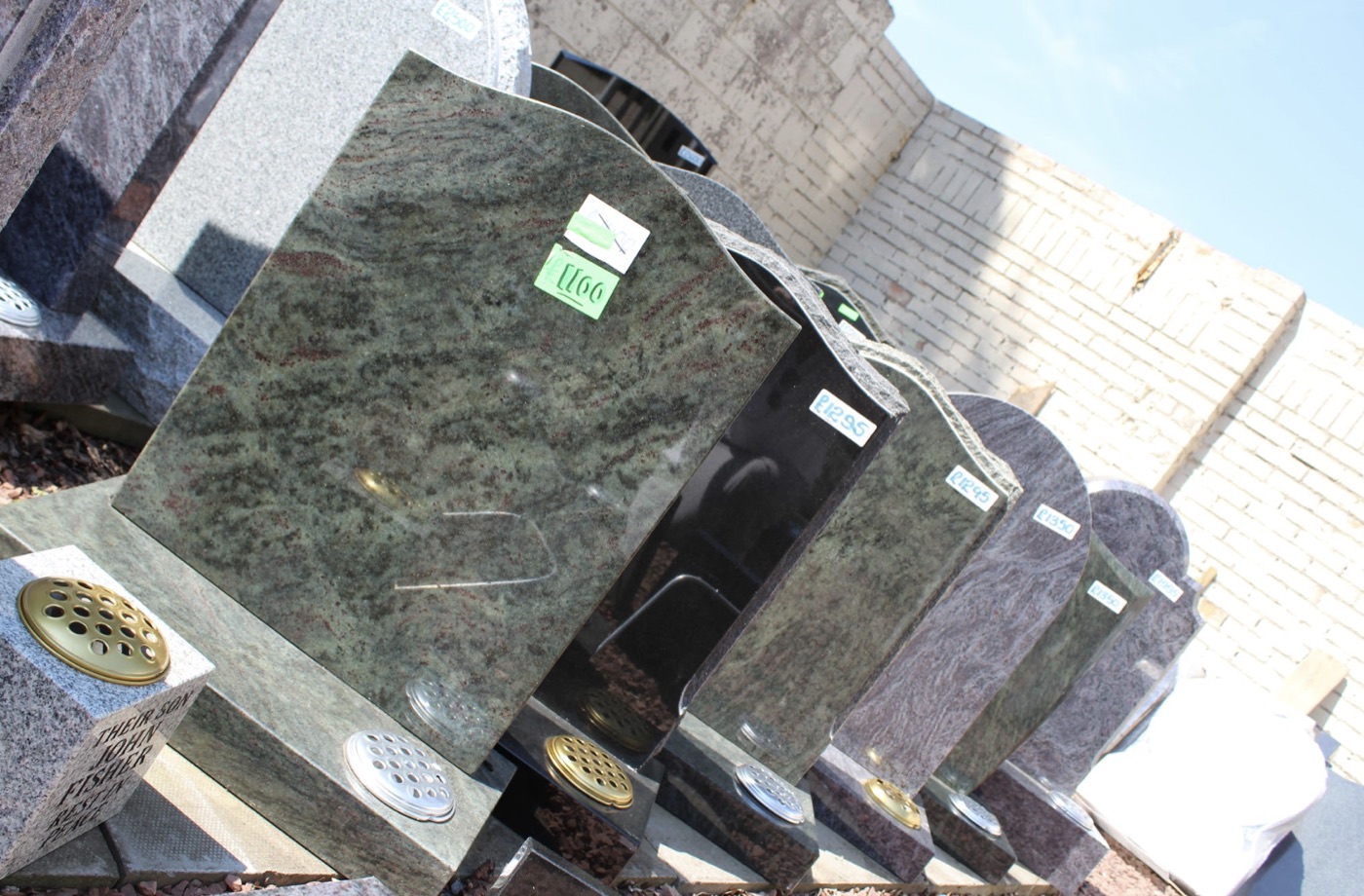
The best granite for a headstone is the one that suits the family and the cemetery, because all four of the granites we use will last for generations. Polished black is the classic and shows gilt lettering most clearly; Vizac Blue is a softer grey-blue; tropical green is deep and quiet; rustic Scottish granite has a natural, split face. The simplest way to choose is to see them side by side in daylight.
What granite colours are available for headstones?
We work with four granites. Each one has its own character, and each suits a different kind of memorial.
- Polished black granite. The classic choice in Scotland, and for good reason. Polished, it has a deep, mirror-like surface that makes lettering stand out clearly from a distance.
- Vizac Blue granite. A soft grey-blue stone. It looks calm and light without being pale, and sits well in older cemeteries where the stones around it are grey.
- Tropical green granite. A deep, dark green. Up close it has real depth; from a distance it reads as a dark, gentle stone.
- Rustic Scottish granite. Granite left with a natural, split face rather than a polished one. It looks honest and weathered from the day it is set, and it suits families who want something plain and rooted in place.
You can see all of them, in finished memorials, on our memorials page.
How does each granite look in Scottish light and weather?
This is the question we would ask first, because a stone chosen under shop lighting can look quite different in a cemetery on a grey afternoon.
Polished black reflects the sky. On a bright day it can look almost like glass; on an overcast day it reads as a solid, deep black. Rain darkens it further and it dries quickly, so it looks tidy most of the year.
Vizac Blue changes the most with the light. In sun it looks lighter and bluer; under cloud it settles into a soft grey. Many families like that it never looks harsh.
Tropical green is at its best in daylight, when the green shows. In dull weather it can look nearly black from a few paces away, which some families find a comfort and others find a surprise, so it is worth seeing outdoors.
Rustic granite does not shine at all. When wet it darkens and the texture of the split face comes forward. Because it is already rough, it does not show the marks of weather in the way a polished face can.
Which lettering reads best on each granite?
All our lettering is hand lettered, in gilt or silver. The right choice depends on the contrast with the stone.
| Granite | Look | Lettering that reads well | Usual finishes |
|---|---|---|---|
| Polished black | Deep, reflective, classic | Gilt is the traditional choice; silver also reads clearly | Fully polished, or part polished with pitched edges |
| Vizac Blue | Soft grey-blue, calm | Gilt or silver, with the lettering cut cleanly for contrast | Fully polished, or part polished |
| Tropical green | Deep, dark green | Gilt sits especially well against the green | Fully polished, or part polished |
| Rustic Scottish | Natural split face, textured | Lettering is set on a polished or smoothed panel so it reads clearly | Rustic split face, often with a polished panel |
Gilt on polished black is the pairing most people picture when they think of a Scottish headstone. It is easy to read from the path and keeps its look for a long time. Silver is a little quieter and suits some families better. If you are unsure, we can show you both on real stones.
What is the difference between polished, part polished and rustic?
The finish changes the feel of a memorial as much as the colour does.
- Fully polished. Every visible face is polished. It is neat, formal and easy to keep clean.
- Part polished with pitched edges. The face carrying the inscription is polished, and the edges are pitched: struck by hand so they break away in a natural, rough line. It gives a contrast between smooth and rugged that many families like.
- Rustic split face. The stone is left largely in its natural state, with the inscription on a smoothed or polished area. It is the least formal of the three.
Any of these finishes can be combined with the shapes we make, from a simple ogee or half-round top to hearts, books and Celtic crosses. If you would like to see how the choices come together, our guide to choosing a headstone takes it step by step.
Can a new stone match an existing family headstone?
Often, yes. When a family is adding a stone beside a parent's or grandparent's, the aim is usually for the two to sit comfortably together rather than to be identical. A stone set decades ago will have mellowed, so a perfect match in colour is not always possible, but the same granite, a similar shape and matching lettering will usually look right.
The most useful thing you can bring is a photograph of the existing stone, taken straight on, with the lettering visible. If you know the cemetery and lair, even better. If the family stone itself needs attention, lettering faded or the stone leaning, we can look at that too through our restoration service. And if a name simply needs to be added to the existing stone, that is often the better answer; see adding an inscription to a headstone.
Why choose granite over marble or sandstone?
Granite is the usual choice in Scotland because it stands up to the weather. It is hard and dense, and a polished granite face keeps its lettering crisp for a very long time.
Marble and sandstone can be beautiful when new, and many of the older stones in Glasgow's cemeteries are made from them. But both are softer. Over the years, rain and frost wear their surfaces, and the lettering slowly loses its edges until it becomes hard to read. Marble can also discolour. That is not a fault of the mason who made them; it is simply the nature of the stone in a wet climate.
So when families ask us which is the longest lasting headstone material, our honest answer is granite, in whichever colour they prefer.
Does the cemetery have rules about granite colour?
Colour is rarely the sticking point. Some cemeteries, or particular sections within them, have rules on size, shape or materials. We check the rules for your cemetery before anything is decided, so you are only choosing from memorials that can be approved. You can read more in our guide to cemetery rules around Glasgow.
Come and see the stones in daylight
Colour is hard to judge from a screen or a brochure. At our display yard you can see every granite outdoors, in whatever light the day brings, with real lettering on real stones. Stand back from them as you would at the cemetery and see which one feels right.
The yard is at 5 Crosshill Road, Bishopbriggs, Glasgow G64 2PZ, by Strathkelvin Retail Park, with parking on site. No appointment is needed, and nobody will follow you round. If you would rather talk first, call us on 0141 762 3733 or email sales@charleslipton.co.uk. We are happy to answer questions, with no obligation at all.
Questions families often ask
Which granite colour is easiest to keep clean?
Polished granite of any colour is easy to look after, as dirt sits on the surface and rinses away. Polished black can show water marks, which a soft cloth removes.
Does black granite fade in the sun?
Good quality polished black granite keeps its colour well in Scottish conditions. Regular gentle cleaning keeps the polish looking its best.
Can I see the granite colours before I decide?
Yes. Every granite we use is on display outdoors at our yard at 5 Crosshill Road, Bishopbriggs, and you are welcome to visit without an appointment.
Is rustic granite less durable than polished granite?
No. Rustic granite is the same hard stone with a natural split face instead of a polish. The lettering is usually set on a smoothed or polished panel so it reads clearly.
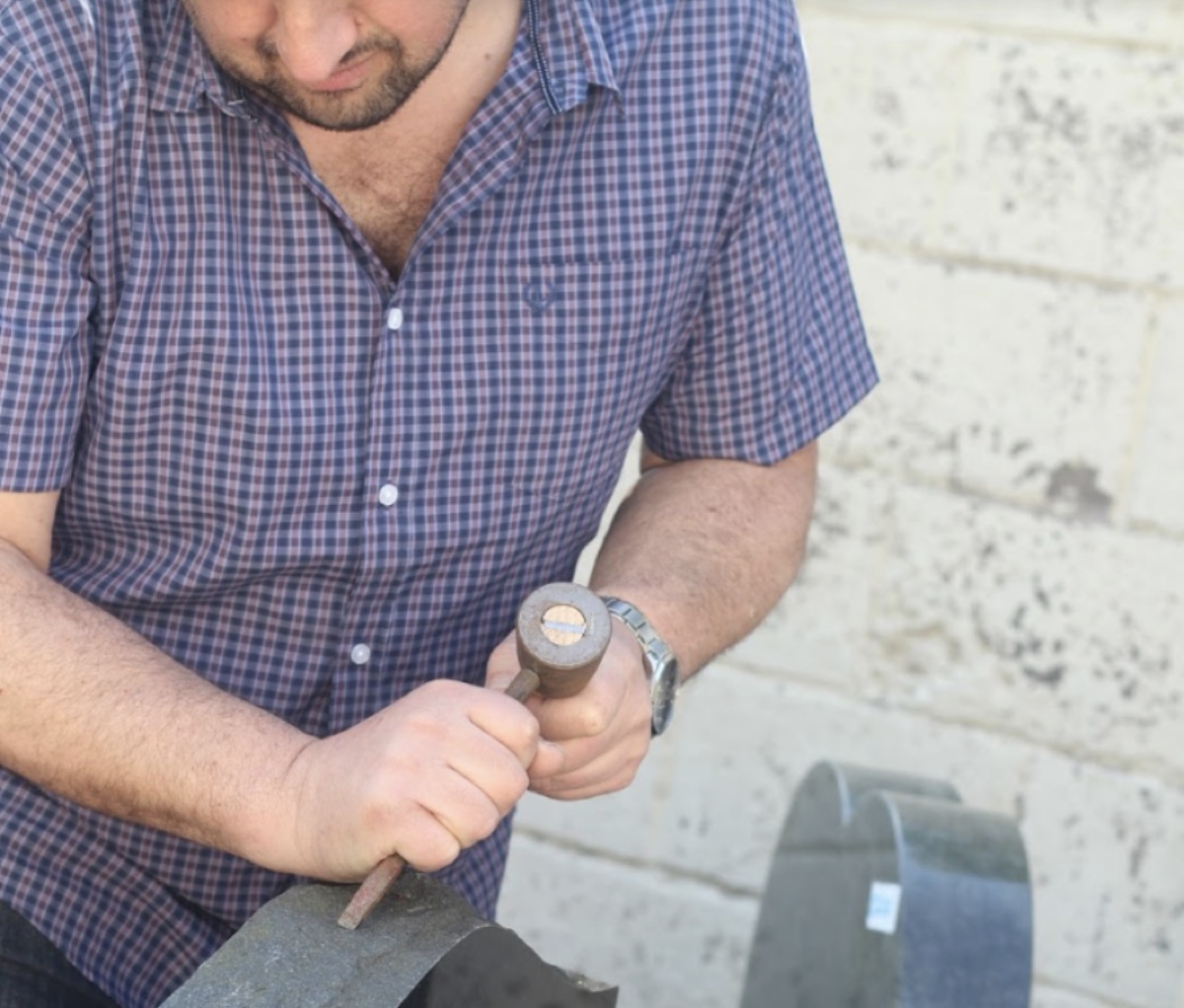
Written by Charles Lipton, third-generation memorial mason with forty years in the trade. The Lipton family has made and cared for memorials across Glasgow since 1927. Read our story.